

While there are many POVs on what great work is or isn’t, at its core, I believe great work creates great value. Its less about perfection, and more about clarity and innovation that actually gets executed. From grandiose endeavors to small projects, great work maximizes what’s possible for the opportunity.
Of course different projects have different potential. While some projects are about executing very well, most projects have the potential for something greater.
New projects begin untouched and full of possibility. And from that moment forward, that potential comes under attack from subtle organizational pressures. Not intentionally. Not dramatically. Just steadily, through the normal pressures of busy organizations: timing, budget, shifting priorities, unclear goals, conflicting objectives, and competing interpretations. It’s a consistent pattern of forces that create a gravity-like pull toward the familiar. These pressures shape the final outcome far more than many leaders would like to admit.
This is not a founder problem, a creative problem, an account service problem, a project management problem, or any other department problem. It’s a cross-functional problem that appears anywhere people are trying to create high-quality work inside organizations that are growing, changing, or simply busy.
The epic battle for work quality.
You can think of the daily tug-of-wars like this:
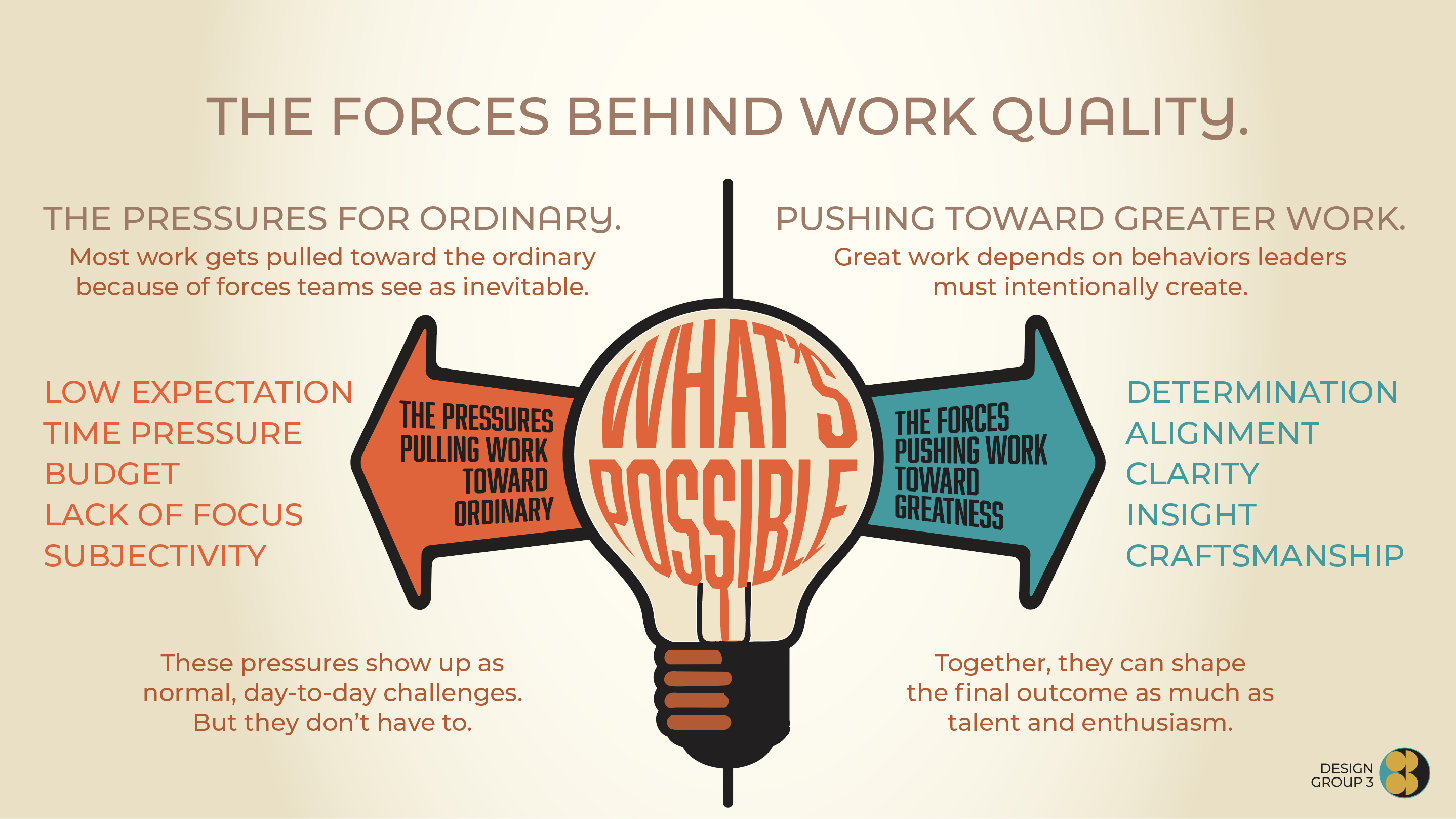
Going deeper on the forces pulling work to the ordinary:
Individually, these factors seem manageable. Together, they create pervasive pull toward polite, competent, forgettable output, or worse.
A common misconception is that this is a raw talent issue. It isn’t. Under the same conditions, even the efforts of top talent struggle to fight these forces. They might be less tolerant, though, since they’ve likely experienced the kinds of leadership that can effectively push for greater work.
Going deeper on pushing work toward greatness:
In my experience, producing great work becomes far more likely if these behaviors are made into habits across the teams.
Growth creates a leadership gap.
Here’s the pattern I see across organizations: Most small teams have the shared understanding required to protect ambition, and it happens naturally when the team is close together. Important conversations happen with a tap on the shoulder.
But as organizations grow, departments develop, proximity decreases and complexity increases, and a leadership gap is created that pulls work toward the ordinary. Proximity needs to be replaced with structure, or things start to fall apart.
Most department leaders can manage well within their function. Far fewer were ever taught to lead across functions, where ambiguity grows, where decisions collide, and where work quality is actually determined.
You may see cross-functional groups that meet often but still fail to align. Teams aren’t failing because they aren’t collaborating. They’re failing because they lack a shared system.
The best leaders focus on shared systems for:
Building shared systems allows every department to protect its own priorities while also working toward far better outcomes by aligning and navigating the ambitions of all.
A simple diagnostic.
Look at your last project. Was it great? Or did it slide to the left, becoming safe, diluted, or compromised? If it turned out ordinary, ask why. Did the reasons include time pressure, unclear goals, shifting expectations, or “too many cooks”?
Great work is a team sport.
Great work does not happen through talent, willpower, or enthusiasm alone. It happens when leaders intentionally recognize and shape the forces that surround the work.
It happens when they create teams that can build a shared language, shared expectations, and a shared system for pulling for and maintaining the conditions for great work.
Greatness is fragile. It needs care, clarity, and shared intent to survive. If you ever want help translating this into something your team can use daily, let’s chat.
If you’d like to explore how this applies to your organization, feel free to reach out. I’d welcome a conversation.

